
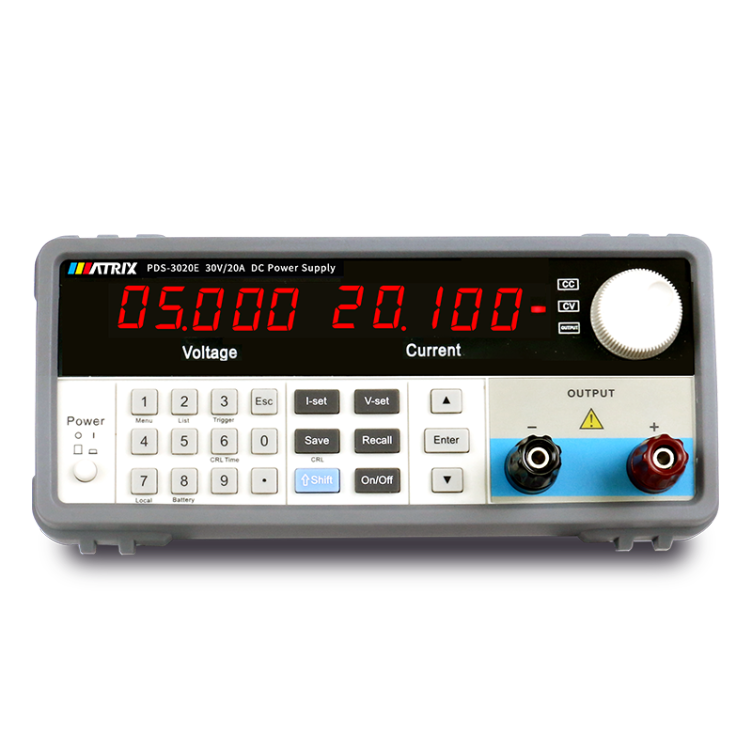
PDS-ESeries High-Stability Programmable DC Power Supply
- Voltage output range: 0~150V; Current output range: 0~60A; Maximum power coverage: 600W~900W
- Battery charging mode with current upper and lower limit setting function and alarm
- Multiple groups of voltage and current storage and recall functions
- Two ways to set voltage and current: numeric keypad and knob adjustment
- Stylish and compact appearance, affordable price, and ultra-high cost performance
Want a custom configuration?
The PDS-E Series is a cost-effective, reliable programmable DC regulated power supply launched by MATRIX Technology Inc. Engineered for balanced performance and usability, this series combines stable linear regulation technology, intuitive operation, and comprehensive protection functions. It delivers low-ripple, high-precision output with fast transient response, catering to routine testing, production line power supply, electronic R&D, and educational laboratory scenarios. Designed as a versatile bench-top solution, the PDS-E Series strikes an ideal balance between affordability and professional performance, making it a go-to choice for daily industrial and scientific power demands.
Built on mature linear regulation architecture, the PDS-E Series ensures clean, stable power output with minimal noise and ripple, safeguarding sensitive electronic components and test samples from damage. Featuring a clear digital display for real-time voltage and current monitoring, this series supports stepless adjustment and programmable parameter settings, enabling users to customize output values quickly and accurately for diversified testing needs.
Engineered with a compact, heat-dissipating shell, the PDS-E Series supports long-term full-load operation without performance drift, maintaining consistent accuracy across extended use. Compliant with global safety standards includingCE and RoHS, it integrates built-in short-circuit, over-voltage (OVP), over-current (OCP), and over-temperature (OTP) protection for full-round operational safety. With standard communication interfaces for remote control compatibility, the PDS-E Series seamlessly connects to automated test systems, boosting efficiency for batch testing and repetitive measurement tasks in modern manufacturing and R&D environments.
Application Scenarios: - Electronic R&D and Debugging: Circuit board testing, prototype verification, sensor calibration, and low-power electronic product development in technical labs and R&D centers. - Industrial Production Lines: Finished product quality inspection, electronic component aging testing, and stable power supply for automated assembly and testing lines. - Educational and Teaching Laboratories: Experimental teaching, student training, and basic electrical/electronic research in universities, vocational colleges and training institutions. - Maintenance and Repair Workshops: Fault detection, performance testing, and power supply debugging for consumer electronics, small electrical devices and industrial modules. - Third-Party Testing and Quality Control: Routine parameter verification, compliance testing, and stability assessment for small-scale electronic products and components.
| Model | Voltage | Current | Power |
|---|---|---|---|
| PDS-2030E | 0~20V | 0~30A | 600W |
| PDS-3020E | 0~30V | 0~20A | 600W |
| PDS-6010E | 0~60V | 0~10A | 600W |
| PDS-1560E | 0~15V | 0~60A | 900W |
| PDS-3030E | 0~30V | 0~30A | 900W |
| PDS-6015E | 0~60V | 0~15A | 900W |
| PDS-8010E | 0~80V | 0~11A | 880W |
| PDS-15006E | 0~150V | 0~6A | 900W |
| Base Specification | Rated input voltage | V220V/110V±10% |
| Transformer mode | Switch power supply | |
| Regulation | Load / Power regulation rate | Voltage: ≤0.1%+20mV | Current: ≤0.1%+5mA |
| Resolution | Setting / Readback resolution | Voltage: 1mV | Current: 1mA |
| Accuracy | Setting / Readback accuracy | Voltage: ≤0.1%+10mV | Current: ≤0.3%+8mA |
| Environment | Temperature Range | Operating: 0~40℃≤85R.H. | Storage: -15~70℃≤85R.H. |
| Physical | Product size (W*H*D) / weight | 230*105*330 mm / 3.5 kg |