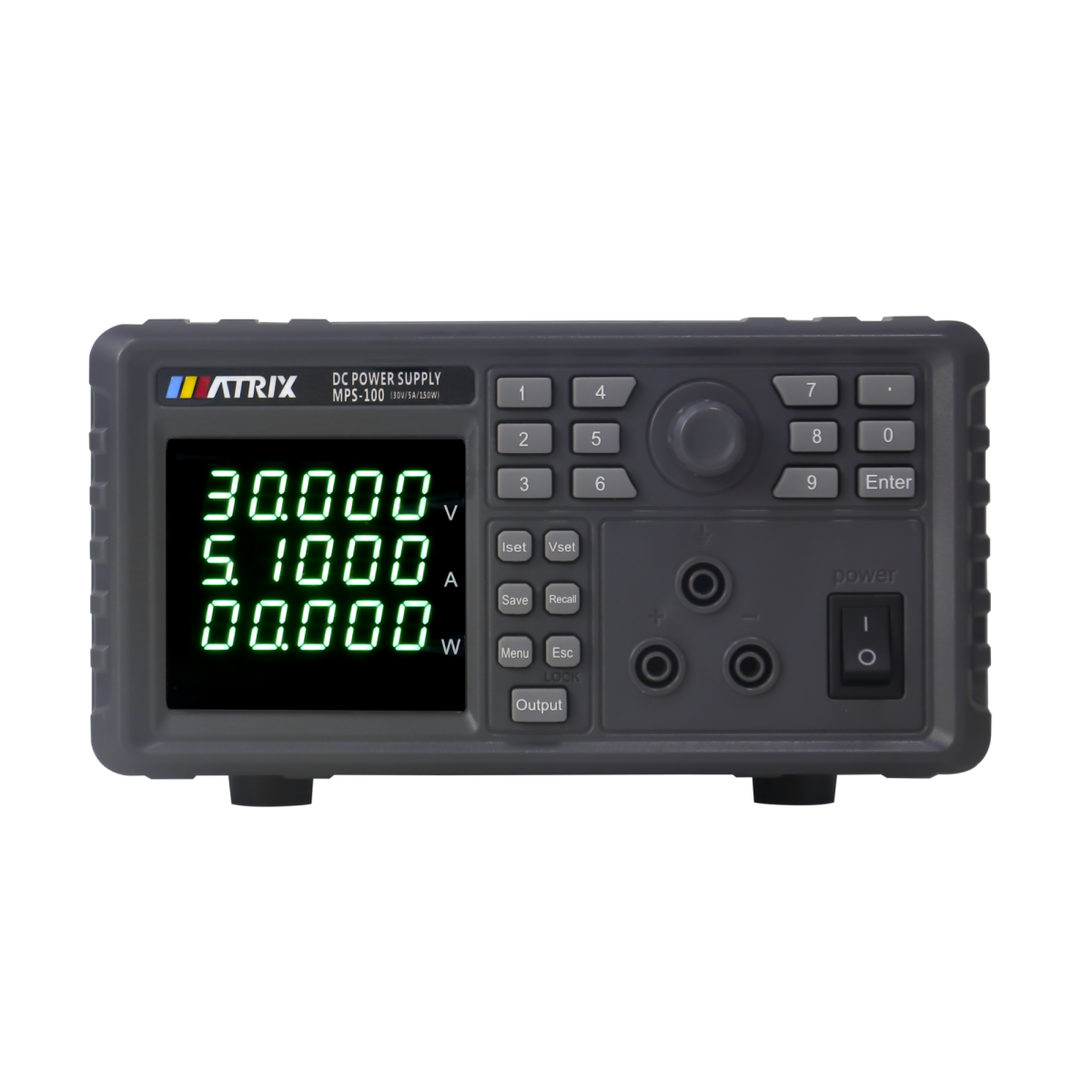
The MPS-100 Series pure linear DC regulated power supply is one of the core products of MATRIX in the DC power supply field, specially designed for scenarios with stringent requirements on power supply precision and stability. The full series covers two power ranges of 30V/5A/150W and 60V/3A/180W, and is divided into basic models and C models with communication functions, which can flexibly meet the usage needs of different users.
In terms of precision performance, the series achieves a voltage resolution of 1mV and a current resolution of 0.1mA. At room temperature of 25℃, the setting and readback accuracy of voltage and current are controlled within an extremely low error range. The voltage ripple and noise are <5mVrms, and the current ripple and noise are <3mArms, which ensures the accuracy of precision testing from the core parameters.
In terms of practical functions, the MPS-100 Series is equipped with a wealth of intelligent designs. First, it supports the List sequence output function, which can set up to 10 steps of sequences and 0-9999 cycles, meeting the needs of complex experiments such as dynamic testing and stepped power supply. Second, it is equipped with 9 groups of common parameter storage/recall functions. Third, it is equipped with an intelligent temperature-controlled fan that can automatically adjust the speed according to the actual load.
In terms of safety protection, the product has a built-in triple comprehensive protection mechanism of over-voltage (OVP), over-current (OCP) and over-temperature (OTP).
In terms of expansion and adaptability, the MPS-100C and MPS-101C models come standard with dual RS-232 and RS-485 communication interfaces, compatible with mainstream industrial protocols of SCPI and MODBUS, enabling remote control, data acquisition and intelligent system integration.
Application Scenarios: R&D and testing of electronic components, Production inspection of industrial products, Teaching experiments, Scientific research experiments in laboratories, Equipment maintenance and debugging.